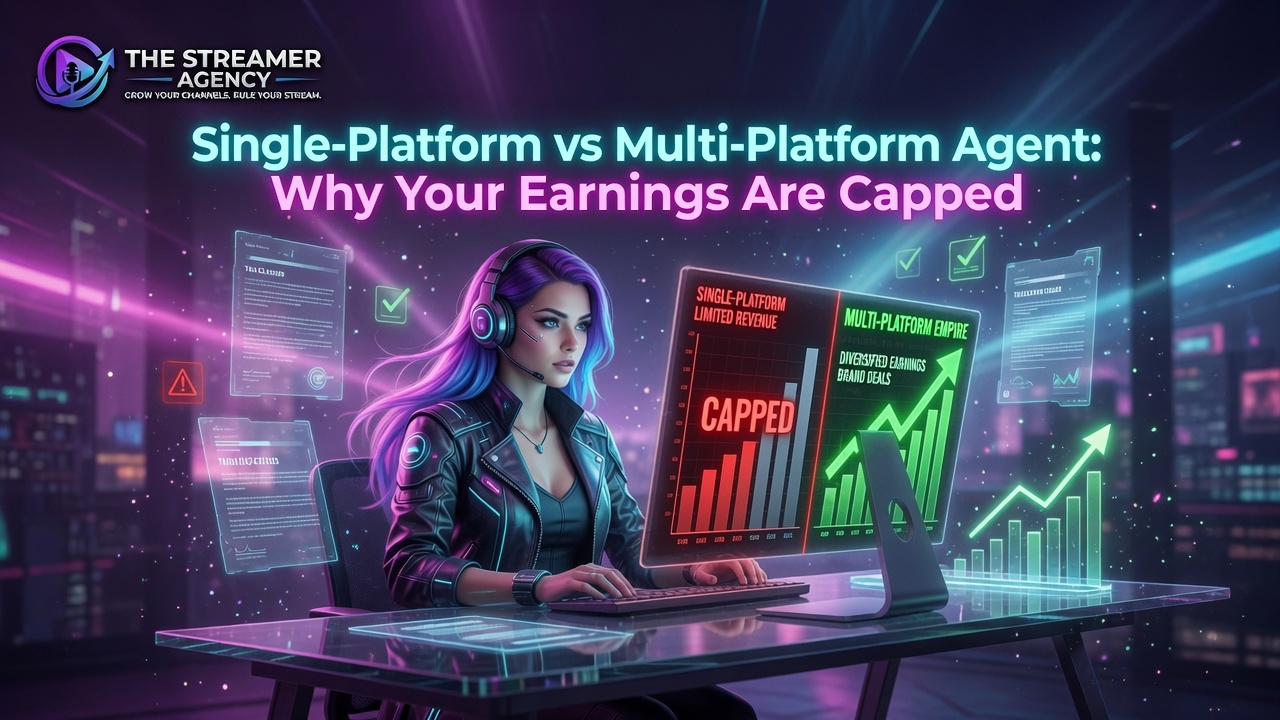
A single-platform cam agent can only place a streamer where that one platform pays, so her earnings are capped by that platform's ceiling for her demographic, not by what she could earn across the streaming economy. A multi-platform agent is agent of record across many platforms at once and places her wherever her audience pays the most.
Quick answer: Single-platform agents represent a streamer on one site (LiveJasmin, Streamate, BIGO) and take 20-30% of that single channel. Multi-platform agents are agent of record across 15+ platforms, place the streamer by demographic-platform fit, and take smaller cuts across the spread - so she keeps a higher percentage of 2-5x more total income. Multi-platform also removes single-platform failure risk: if one site suspends accounts or cuts payouts, the others keep earning. The Streamer Agency operates across 25+ platforms.
Most cam agents represent streamers on a single platform. LiveJasmine. Streamate. Camsoda. BIGO. Pick one. Their agency is built around that platform's economics, that platform's payout schedule, that platform's audience demographic. The streamer gets placed where the agent operates. That is the entire model.
It is also the entire problem.
The cap nobody talks about
Different platforms pay different demographics differently. LiveJasmine premium-tier earnings look very different from Streamate. BIGO pays its top earners on a Beans-to-Diamonds conversion that has nothing in common with how Flirt4Free pays its male performers. OnlyFans subscription revenue scales by audience nurture in ways no live-streaming platform replicates.
Earnings ceilings differ by platform, and each network sets its own payout terms, such as the Bigo Live site.
A streamer represented by a single-platform agent is locked into that platform's earnings ceiling for her specific demographic. The agent does not have visibility into where she would earn more. The agent does not have agent-of-record status anywhere else. The agent has no incentive to move her, because moving her means losing the commission.
That is the cap. The streamer's earnings are bounded by the platform her agent works on, not by what she could earn across the streaming economy.
Why agents stay single-platform
Becoming an agent on a single platform requires onboarding, application, identity verification, payment account setup, and demonstrating that the agent has at least one streamer to represent. Multiply that by 5 or 10 platforms and the operational complexity scales nonlinearly. Most agents do it on one platform and stop. Some platforms never finish processing the application at all; read our Bigo agency record, with dates.
That works fine for the agent. It does not work for the streamer.
The streamer who signs with a single-platform agent has accepted, by contract, that her income from every other platform is either nonexistent (she is not on those platforms) or unrepresented (she manages those accounts solo, with no agency support, no placement optimization, no income lift).
What a multi-platform agent does differently
A multi-platform agent is agent of record across many platforms simultaneously. The streamer signs once. She is placed across every platform where her demographic earns the most. The agent optimizes placement based on actual data: which platform pays her audience type the most per stream-hour, where her aesthetic resonates highest, which subscription model fits her content pattern.
The math compounds. A streamer earning $5,000 per month on a single platform under a single-platform agent might earn $4,000 on that platform plus $3,500 on a second platform plus $2,000 on a third under a multi-platform agent. Her total income is $9,500 instead of $5,000. The agency cut comes out of more dollars, but the streamer keeps more total dollars than she would on the single-platform model.
Multi-platform also removes the platform-failure risk. If one platform shuts down, suspends accounts, or changes payout terms unfavorably, the streamer's other platforms continue earning. Single-platform representation concentrates all income risk on one operational dependency. Multi-platform diversifies it structurally.
The agent incentive alignment
Single-platform agents have one income source per streamer: their cut of that one platform's earnings. Their entire business model concentrates on extracting maximum cut from a single channel.
Multi-platform agents have income across the full platform mix. The cut per platform is smaller, but the total is larger because the streamer's total income is larger. The agent and streamer both benefit when earnings grow across the spread.
Multi-platform agents also have less incentive to lock streamers into restrictive contracts, exclusivity clauses, or punitive tail-clause structures. The relationship sustains itself through actual value delivery, not through contractual entrapment. If the streamer is earning more under multi-platform representation than she could solo, she stays. If she walks, she pays a small ongoing percentage (5% at TSA, vs. 25% industry-standard) for a limited window, then is free. No lockup, no extraction.
What this means for streamers evaluating agents
The first question a streamer should ask any agent: "Are you my agent of record on more than one platform?"
If the answer is one or two, the agent is structurally bounded by what those platforms pay. The streamer's earnings will be too.
If the answer is many (10+), the agent has the operational reach to optimize her placement across the streaming economy. Her income ceiling is set by her own performance, not by the agent's single-platform infrastructure.
The Streamer Agency operates as agent of record across more than 25 platforms. That is the structural reason our streamers consistently outperform single-platform peers across comparable demographics. It is not magic. It is just having access to where the audience actually pays.
Frequently Asked Questions
What is multi-platform agent representation?
Multi-platform agent representation is a model where a single agency operates as agent of record for a streamer across many cam and subscription platforms simultaneously (typically 20+). The agency places the streamer on the specific platforms where her demographic earns the most rather than restricting her to one platform. The streamer's aggregate earnings across the platform mix are typically 2-5x what single-platform representation would produce.
How many platforms does a multi-platform agency need to be on?
To meaningfully outperform single-platform agents, a multi-platform agency should be agent of record on at least 15 platforms covering the major streaming categories (premium cam, subscription content, tip-based, regional, and specialty platforms). The Streamer Agency operates across 25+ platforms specifically because the demographic-platform matching benefits from broad coverage.
Does multi-platform mean I have to stream on all the platforms?
No. Multi-platform representation means your agent CAN place you on any of the covered platforms. Actual placement is optimized per streamer based on demographic fit, content type, audience pattern, and earnings projection. Most streamers end up actively operating on 5-10 platforms, not all 25+.
Will multi-platform agencies take a higher cut than single-platform agents?
Counterintuitively, no. Single-platform agents take 20-30% from one income source because it is their only revenue. Multi-platform agents take smaller cuts across the spread because the aggregate produces their revenue. Streamers typically keep a higher percentage of more total dollars under multi-platform representation than they would under single-platform extraction.
Can I switch from single-platform to multi-platform representation if I am already under contract?
Yes, but timing depends on your current contract terms. Most single-platform contracts include tail clauses (continuing commission after termination) and exclusivity provisions. Switching requires either waiting until those provisions expire, negotiating a buyout, or terminating with documented breach grounds. A contract attorney can evaluate your specific situation. Multi-platform agencies often help plan the transition timing.
How to evaluate the multi-platform fit
Schedule a representation call and we will talk through your current platforms, your audience demographic, and where your earnings would scale across the platforms we cover. No commitment to start. We tell you honestly where the math says you should be.
If you want to understand the broader streamer economy before committing to any representation model, The Streamer Academy is our internal training program covering platform mechanics, audience dynamics, and earnings optimization across the industry.
If you are still exploring what professional streaming looks like as a career, How to Become a Professional Streamer is the entry guide most aspiring streamers start with.
The earnings cap on single-platform representation is not a personal limit. It is a structural one. Multi-platform unlocks it.